Why Electric Golf Carts Refuse to Start After Long Storage
Electric golf carts are engineered for quiet, efficient transport across residential communities, luxury resorts, and sprawling university campuses. They are the workhorses of short-distance mobility, offering a seamless blend of comfort and utility. However, a common frustration arises when these vehicles are left parked for extended periods. After months of storage, even the most well-maintained golf carts can feel completely “dead” on the very first day you try to use them.
In most cases, this refusal to start isn't due to a catastrophic failure of the motor or a mysterious breakdown of the controller. Instead, it is almost always a predictable combination of battery state of charge, small but constant standby loads, terminal condition, and ambient temperature fluctuations. Understanding the interaction between your golf cart's power system and its storage environment is key to ensuring reliability when you turn the key.

The Silent Drain: What Goes Wrong During Storage
When golf carts sit idle for too long without proper preparation, they fall victim to the physics of battery chemistry. If a cart is stored with a battery that is already low on charge, the natural rate of self-discharge accelerates the depletion. Furthermore, modern carts are often equipped with "always-on" accessories—digital dash screens, clocks, reversing image systems, and smart controllers—that draw a tiny amount of current even when the vehicle is turned off.
Over weeks or months, these parasitic drains can pull the battery pack voltage below the critical threshold required for the Inbol controller to wake up. The controller is the brain of the operation; if it doesn't sense enough voltage, it assumes the battery is damaged and prevents the system from engaging to protect the components.
For traditional lead-acid battery packs, the risk is compounded by sulfation. This chemical process occurs when batteries remain in a state of partial discharge. Lead sulfate crystals form on the battery plates, hardening over time. This crystallization drastically increases internal resistance and reduces the battery's usable capacity. If left unchecked, these crystals can become permanent, ruining the battery pack. Cold weather exacerbates this entire scenario by slowing down the chemical reaction inside the battery, effectively lowering the available voltage under load just when you need it most.
Our Power Configuration: Optimized for Reliability
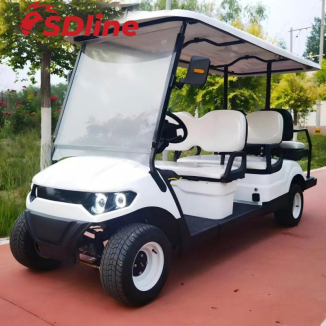
To combat these issues, we ensure our electric golf carts—including the popular SDLG-A, B, C, and D series—are equipped with robust power systems designed to handle the rigors of daily use and intermittent storage. Many of our standard configurations feature the high-capacity Chaowi lead-acid battery 72V100A+. We select this 72V system because it offers a higher voltage headroom compared to standard 48V systems, providing a buffer against voltage drop.
This battery pack is paired with a powerful 4000W Depuda motor and the intelligent Inbol controller. The 4000W motor provides exceptional torque for climbing hills in resorts or navigating uneven terrain in parks, but it demands a healthy energy source. The Inbol controller acts as a safeguard, managing the flow of energy to the motor.
However, lead-acid chemistry rewards discipline. To get the most out of our SDLG series—whether you are using the 2-seat, 4-seat, or the versatile 2+2 facing layout—you must store the vehicle fully charged. Keeping the terminals clean from corrosion and avoiding deep discharge cycles will ensure that components like the 12-inch aluminum beach wheels and the large digital screen are ready to go the moment you return.
Lithium Upgrades and the Importance of BMS
For fleet operators managing large numbers of vehicles in golf courses or scenic spots, moving from lead-acid to lithium (such as LiFePO₄) is becoming an increasingly popular upgrade. Storage performance can improve significantly with lithium, but only if the Battery Management System (BMS) is designed for real-world fleet conditions.
A high-quality BMS does more than just balance cells. It actively monitors per-cell voltage, manages temperature sensing, and enforces over/under-voltage cutoffs. Crucially for storage, a strong BMS features a low-power sleep mode. This function puts the battery into a deep hibernation when not in use, drastically reducing self-discharge rates. These intelligent functions help prevent the deep discharge events that kill lead-acid batteries and significantly reduce "won't start" service calls after long seasonal parking.

| Topic | Lead-acid (common) | Lithium (OEM option) |
|---|---|---|
| Storage risk | Sulfation at low charge; high self-discharge | Protective cutoff if over-discharged; BMS lockout |
| Best practice | Keep at a higher state of charge; charge monthly | Use storage/sleep mode when available |
| Cold impact | Capacity/voltage drop is noticeable | Better retention, though still temperature-sensitive |
A Storage Checklist That Keeps Golf Carts Ready
Whether you operate a single cart for your villa community or a fleet for a tourist attraction, following a strict protocol ensures uptime. Here is the checklist we recommend for all our customers:
- Before parking: Ensure the vehicle is fully charged. Clean the battery terminals to remove any grime or potential corrosion points. Tighten all connections. Park the cart in a dry, ventilated area to protect the folding glass windshield and luxury seats from environmental damage.
- During storage: Switch off all non-essential accessories. Even the digital display or a USB charger left plugged in can drain the pack. For lead-acid systems, we recommend checking the voltage monthly and applying a refresh charge if it drops below the recommended level.
- Restart day: Before turning the key, inspect all cables for corrosion or loose lugs. Check the tire pressure on the 12-inch beach wheels. Confirm the pack voltage. If you have a lithium system that shows zero voltage, it may be in protection mode; follow the BMS wake-up procedure rather than repeatedly cycling the key, which can damage the ignition switch.
Buyer Questions for OEM Projects
If you are sourcing golf carts directly from the factory, looking beyond the aesthetic options is vital. While our SDLG series offers customizable colors and seating arrangements (2, 4, 5, or 6 seats), the technical backbone determines reliability.
When discussing your order, ask for written guidance on storage State of Charge (SOC) targets and recommended charger behaviors. If opting for lithium, inquire about the exact BMS functions and sleep current specifications. These technical details determine the long-term uptime of your fleet far more than cosmetic options like the style of the rearview mirrors or the storage rack design. Our production follows recognized international quality systems, including ISO, SGS, and CE standards, ensuring that every vehicle we ship meets rigorous global requirements for safety and performance.
To discuss OEM/ODM configurations for seating, accessories, and power systems for electric golf carts, browse our Electric Golf Cart category and contact our team via WhatsApp.
References
- Lu, L., Han, X., Li, J., Hua, J., & Ouyang, M. (2013). A review on the key issues for lithium-ion battery management in electric vehicles. Journal of Power Sources. https://doi.org/10.1016/J.JPOWSOUR.2012.10.060
- Uddin, K., Perera, S., Widanage, W. D., Somerville, L., & Marco, J. (2016). Characterising lithium-ion battery degradation through identification and tracking of electrochemical model parameters. Batteries. https://doi.org/10.3390/BATTERIES2020013
- Lai, C.-M., & Kuo, T.-J. (2022). Available capacity computation model for gelled-electrolyte batteries in golf carts. IEEE Access. https://doi.org/10.1109/ACCESS.2021.3123789
- Fernández, E. M. (2018). Diseño e implementación de un sistema de gestión de baterías (BMS) para una moto eléctrica de competición. Semantic Scholar. https://www.semanticscholar.org/paper/Dise%C3%B1o-e-implementaci%C3%B3n-de-un-sistema-de-Fern%C3%A1ndez/e2f3f4b2a2b2a2b2a2b2a2b2a2b2a2b2a2b2a2b2
- Habib, A. K. M. A., Hasan, M. K., Issa, G. F., Singh, D., Islam, S., & Ghazal, T. M. (2023). Lithium-ion battery management system for electric vehicles: Constraints, challenges, and recommendations. Batteries. https://doi.org/10.3390/batteries9030152