Stored Golf Cart Downtime Starts With Battery and Charging Basics
When a golf cart sits idle in a resort, campus, or residential community, the next “turn-key moment” can quickly turn into an operational headache. For fleet managers and property owners, ensuring vehicle readiness is not just about turning a key; it is about a disciplined approach to maintenance. At KATAR, we understand that battery care, charger matching, and pre-delivery checks are the deciding factors between an electric golf cart that returns to service smoothly and one that results in costly downtime.

Diagnosing the "Restart" Challenge After Storage
In real-world operating environments, electric golf carts often face periods of inactivity, whether due to seasonal changes or fluctuating demand. A common issue we encounter is the refusal of a cart to start after weeks of storage. This is rarely a manufacturing defect in high-quality units but rather a symptom of battery chemistry and connection health.
For fleet owners managing our SDLG series or similar models, the most reliable approach is to treat "restart day" as a structured process rather than a simple switch-on. The core of this process revolves around the power unit. Our vehicles typically come equipped with robust Chaowi lead-acid batteries (72V100A+), designed for deep cycling. However, even the best batteries require specific care protocols during dormancy. Sulfation can occur on lead plates if the voltage drops below a critical threshold, effectively "locking" the energy potential.
To prevent this, we recommend a three-step verification process before the season begins:
- Verify Battery Configuration: Ensure the maintenance charging profile matches the specific battery pack installed. Mismatched voltages are a primary cause of premature failure.
- Inspect Physical Connections: Corrosion on terminals can create high resistance, leading to heat buildup or failure under load. A visual check of all wiring harnesses connected to the Inbol controller is essential.
- Staged Return-to-Service: Instead of immediately subjecting the golf cart to a full 18-hole round or a day of heavy campus shuttling, perform a short test run to monitor voltage sag under acceleration.
The Critical Role of Charging Infrastructure
Mixed fleets often create a quiet but significant bottleneck: charging inconsistency. Daily availability is shaped as much by the ecosystem around the vehicle as by the electric golf cart itself. We often see facilities where chargers are swapped indiscriminately between vehicles of different voltages or amperages, leading to incomplete charge cycles or overheated components.

A practical takeaway for any golf cart fleet is to establish simple, consistent charging rules. Designated charging stations with clear labeling prevent "charging chaos." Furthermore, using the correct charger ensures that the intelligent charging algorithms can properly balance the battery cells. This is particularly important for maintaining the longevity of the 72V system, ensuring that your fleet remains ready for deployment at a moment's notice.
Addressing Range Anxiety Through Engineering
Range anxiety is a measurable cost for any operation, including resorts, gated communities, and rental businesses. Operators often fear that an electric golf cart will become stranded mid-shift. At KATAR, we believe that extending range is not solely about adding more battery capacity, which adds weight; it is about designing a system that maintains efficiency under real operating conditions.
Our engineering approach focuses on the synergy between the motor and the controller. We utilize a 4000W Depuda motor paired with a precision-tuned Inbol controller. This combination ensures that energy is used efficiently, whether the cart is navigating flat turf or climbing a gradient in a villa community. By optimizing the torque delivery and regenerative braking capabilities, we can squeeze more range out of the standard battery pack without compromising safety or stability.
Furthermore, mechanical efficiency plays a huge role. Components like the 12-inch aluminum beach wheels are selected not just for aesthetics but for their rolling resistance profile. Ensuring tires are inflated to the correct pressure and that wheel hubs are free of debris significantly reduces the energy required to move the vehicle, thereby extending the operational range.
Ensuring Quality: What to Look For in Manufacturing
For buyers sourcing directly, understanding the manufacturing quality is paramount. When evaluating an electric golf cart, one must look beyond the exterior plastic shell. The integrity of the chassis, the quality of the painting process (electrophoresis is preferred for rust prevention), and the standard of the electrical cabling are true indicators of durability.
We adhere to strict international standards, including ISO, SGS, and CE certifications. This commitment to quality ensures that every vehicle leaving our factory—whether it is a 2-seater for the course or a 4-seater for sightseeing—meets rigorous safety and performance benchmarks. An audit of these elements before shipment helps prevent costly issues after freight and warehouse delays, ensuring that the product you receive is ready for immediate integration into your fleet.
Our Product Solutions and Specifications
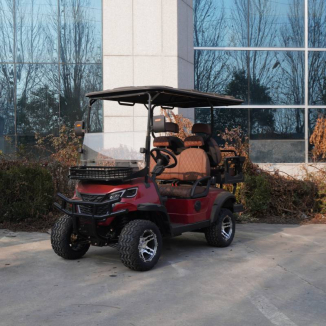
Our SDLG series is designed to meet these diverse needs, offering a balance of power, comfort, and reliability. Whether you need a vehicle for a golf course, a real estate property tour, or a tourist attraction, our configurations can be tailored to your specific requirements.
Key Product Parameters:
| Component | Specification |
|---|---|
| MOTOR | 4000W Depuda motor |
| BATTERY | Chaowi lead-acid battery 72V100A+ |
| CONTROLLER | Inbol controller |
| WHEEL | 12-inch beach wheels (aluminum) |
| SCREEN | Large digital screen with reversing image |
| SEATS | Luxury seats with headrests |
| PEDALS | Combination pedals |
| GLASS | Folding windshield |
These vehicles also feature practical elements like a folding glass windshield, a rearview mirror, and a caddy rack, making them versatile for both sport and utility. The inclusion of a large screen with a reversing image enhances safety in crowded environments like amusement parks or residential zones.
Customization and Fleet Integration
We recognize that no two operations are identical. That is why we offer comprehensive OEM and ODM customization services. If our standard colors do not align with your corporate branding, we can modify them to your specifications. From adjusting the wheel style to configuring the seating layout (2-seat, 4-seat, 5-seat, or 2+2-seat), our goal is to provide a golf cart that fits seamlessly into your operations.
For those requiring specific performance adjustments, such as engine modifications or unique logo placements, our team is ready to assist. Managing a fleet is complex, but with the right equipment and maintenance protocols, your electric golf cart fleet can become a reliable asset rather than a maintenance burden.
For technical consultation, detailed storage instructions, or project inquiries, please reach out to our team. We are here to help you optimize your fleet's performance.
Contact Us:
Katerina
WhatsApp | Email: Katerina@sdlanch.com