Golf Cart Instruction Manual
Golf Cart Instruction Manual
Table of contents
01. Product Uses | 06. Maintenance and Storage |
02. Main Technical Parameters | 07. Vehicle maintenance and after-sales service |
03. Introduction to Core Components | 08. Common Problems and Solutions |
04. Operating Method | 09. Detailed vehicle installation video |
05. Charging Precautions | 10. Product Parts Introduction |
Product Uses
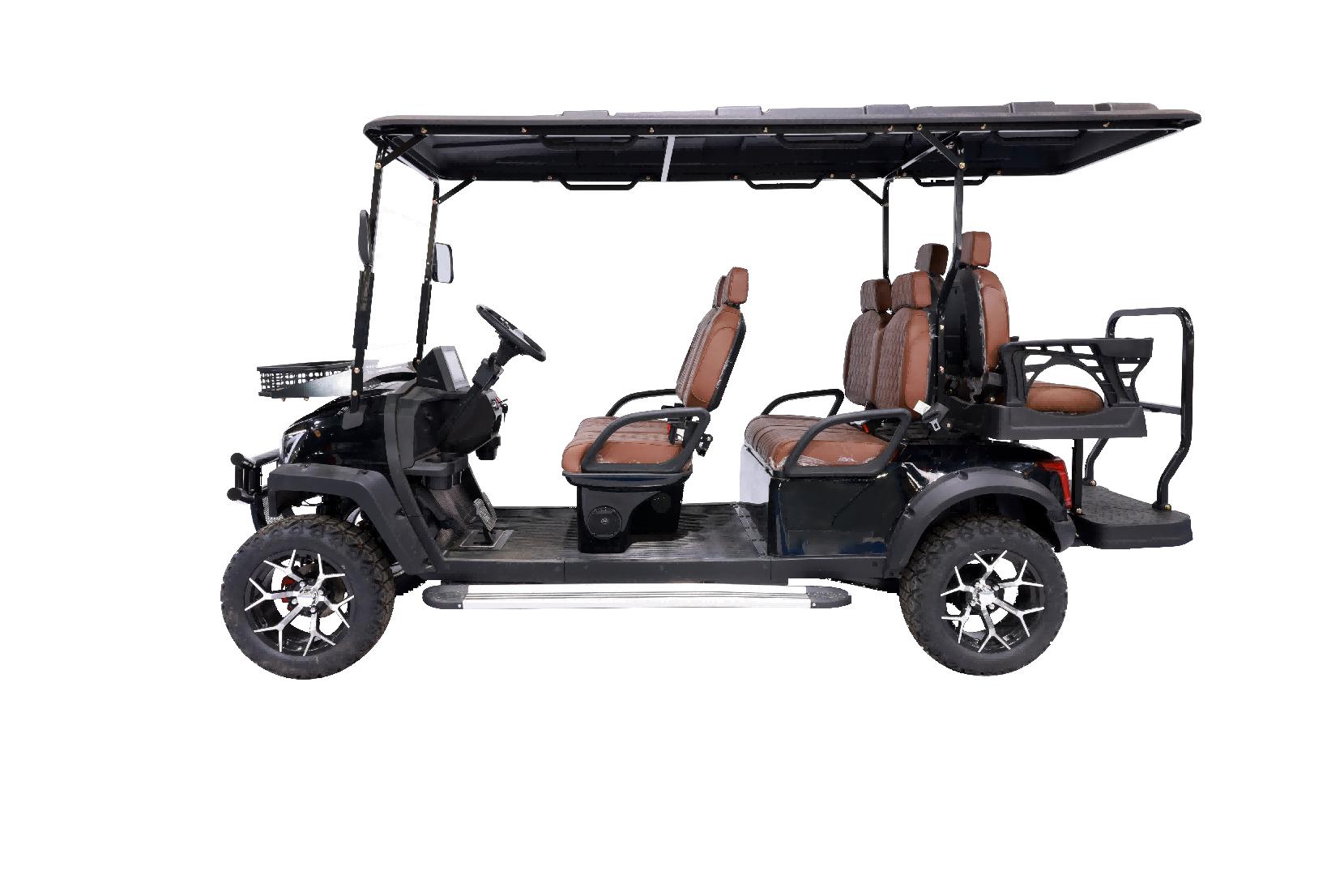
SDLGC100 It is a short-distance transportation tool designed specifically for golf courses. It is mainly used to carry players, golf equipment and related items on the golf course .
It can also be used for short-distance transportation needs in closed or semi-closed areas such as resorts, scenic spots, and villa areas.
The product features easy operation, smooth driving, and environmental friendliness and energy saving.
Main technical parameters
Parameter name | Specifications and Models | Parameter name | Specifications and Models |
Battery | 60V 105A | windshield | Foldable |
chassis | High-strength carbon steel | steering wheel | carbon fiber material |
motor | 5kw | Brake disc size ( mm ) | 205 |
Tire size | 23*10--14 inches | Charging time ( h ) | 10 |
Braking distance | 40km/h 5m | Charger length ( mm ) | 1700 |
controller | intelligent controller | Charging voltage | 90-264VAC |
Passenger capacity | 6 | Total vehicle weight ( kg ) | 580 |
Maximum speed ( km/h ) | 40 | Overall vehicle dimensions ( mm ) | 3700*1290*2050 |
range | > 80 | Maximum climbing angle | 25% |
Introduction to core components
1. Body System Made of high-strength aluminum alloy, it is corrosion-resistant and lightweight, and includes a driver's seat, passenger seat, equipment rack, storage box and other structures.
2. Power System Composed of a battery pack, motor, and controller, it provides power for vehicle movement. The controller can perform functions such as speed regulation and power distribution.
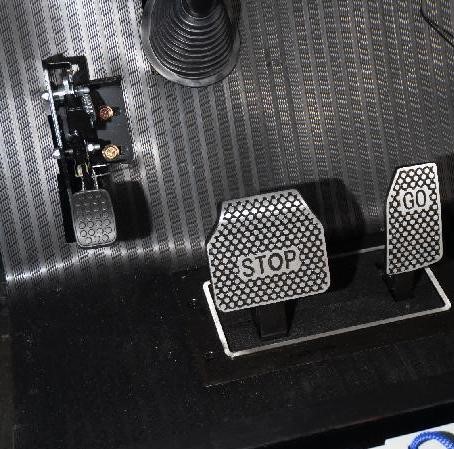
3. Control System It includes a steering wheel, accelerator pedal, brake pedal, parking brake, forward / reverse switch, etc., used to control the vehicle's driving status.
4. Electrical System It includes an instrument panel, lights (headlights, turn signals, brake lights), horn, charging port, etc., to realize vehicle status display and basic function control.
5. Chassis System It consists of a frame, suspension system, and wheels, ensuring vehicle stability and handling.
Operating method
Startup Operation
( 1 ) Insert the key and rotate it clockwise to the "ON" position (for keyless start models, press the start button). The instrument panel will light up and display information such as battery power and vehicle status.
( 2 ) Confirm that the forward / backward switch is in the " neutral " position, check the surrounding environment, and ensure that there are no obstacles or pedestrians.
( 3 ) Depending on the driving direction, switch the forward / reverse switch to the " forward ( D ) " or " reverse ( R ) " position. At this time, the instrument panel will display the corresponding driving direction indicator.
( 4 ) Slowly release the parking brake and gently press the accelerator pedal to start the vehicle smoothly.
Driving control
( 1 ) Speed adjustment: The driving speed is adjusted by controlling the pressure of the accelerator pedal. The greater the pressure, the faster the speed. After releasing the pedal, the vehicle will slow down slowly.
( 2 ) Steering operation: Turn the steering wheel to control the direction of the vehicle. When turning, you should slow down in advance and operate slowly according to the steering angle to avoid sharp turns.
( 3 ) Braking operation: When it is necessary to slow down or stop, lightly press the brake pedal. The force of pressing the pedal is proportional to the braking force. In case of emergency braking, you can press it down a little harder, but you need to be careful to prevent passengers or objects from moving forward due to inertia.
( 4 ) Direction switching: When it is necessary to switch forward / backward direction, the vehicle should be completely stopped first, and then the switching switch should be turned to the corresponding position to avoid loss of vehicle control when switching direction while driving.
Charging Precautions
( 1 ) When the battery pack charge is below 20% (red area on the dashboard), it should be charged in time to avoid deep discharge and extend the battery life.
( 2 ) The charging time is usually 8-12 hours. After it is fully charged, the power should be disconnected in time. Overcharging for a long time (more than 15 hours) is prohibited to prevent the battery from bulging, leaking or being damaged.
( 3 ) During the charging process, the charger and battery pack may get slightly hot, which is normal. If there is any abnormal situation such as severe heat, odor, or smoke, the power plug should be unplugged immediately, charging should be stopped and a repair person should be contacted.
( 4 ) It is forbidden to drive the vehicle while it is charging, and it is also forbidden to plug or unplug the charging gun while the vehicle is in motion. ( 5 ) When the vehicle is not used for a long time, the battery should be fully charged first, and then recharged every 1-2 months to avoid storing the battery with a low charge.
( 6 ) When charging in the rain, ensure that the charging interface and charger plug are dry and avoid rain splashing to prevent short circuit.
( 7 ) Do not use chargers that are not original or do not meet specifications, otherwise the battery may be damaged or a safety accident may occur.
Maintenance and storage
Regular maintenance (monthly or after 500 kilometers)
( 1 ) Chassis inspection: Check whether the frame is deformed or rusted, whether the springs and shock absorbers of the suspension system are intact, and whether the connection parts are firm. Add lubricating oil if necessary.
( 2 ) Steering system: Check whether the steering wheel clearance is too large, and whether the steering tie rod and ball joint are loose. If there are any abnormalities, adjust or replace them in time.
( 3 ) Motor and controller: Check whether there are signs of overheating on the motor casing, whether the controller wiring is secure and undamaged, ensure good heat dissipation, and do not block the motor heat dissipation holes.
( 4 ) Charging system: Check whether the charging interface and charger plug are worn, and whether the charging circuit is aged. Ensure that the connection is reliable and the insulation is good. Long-term storage and maintenance (not used for more than 1 month)
Long-term storage and maintenance (not used for more than 1 month) .
( 1 ) Clean and dry the vehicle and park it in a dry, ventilated, and dark indoor environment, avoiding direct sunlight, rain or sun exposure.
( 2 ) Fully charge the battery pack, turn off the main battery switch (if equipped), and unplug the charger.
( 3 ) Use a jack to lift the vehicle so that the tires are off the ground and avoid the tires from being deformed by long-term pressure; if there is no such condition, the vehicle can be moved periodically to change the position of the tires.
( 4 ) Cover the seats, steering wheel and other parts that are prone to aging with dust cloth to avoid dust accumulation and material aging.
( 5 ) Charge the battery every 1-2 months to ensure that the battery has sufficient power.
Vehicle maintenance and after-sales service
To protect our customers ' rights and ensure they receive excellent after-sales service when using our products, please read the following carefully.
After purchasing products from our distributors, please read the instruction manual carefully and operate the product correctly according to the instructions. During the warranty period, our company promises to repair or replace defective parts caused by quality issues such as material, manufacturing, and design problems.
From the date of manufacture to six months or 10,000 kilometers (whichever comes first, calculated from the date of purchase).
( 1 ) Free repair service shall be provided in accordance with the "Regulations on Quality Warranty of Dalu Electric Vehicles".
( 2 ) Tires, seat cushions, backrests and other easily damaged parts are not covered under warranty. If damaged during use, please contact the manufacturer.
( 3 ) If a batch of quality problems occur, our company will send technicians to repair or recall the defective products (including domestic and foreign products).
( 4 ) Long-term paid services will be provided after one year.
The following quality issues are not covered under warranty:
( 1 ) It was not used in accordance with the instructions.
( 2 ) The repair was not carried out at the repair point designated by the company.
( 3 ) The warranty period has expired.
( 4 ) No original parts were used.
( 5 ) Unauthorized modification without the company’s permission.
( 6 ) Overloading.
( 7 ) Caused by force majeure such as typhoons, floods, earthquakes, wars, etc.
( 8 ) Faults caused by failure to entrust this electric vehicle dedicated service station to carry out repairs.
( 9 ) During the vehicle break-in period, the user failed to use, maintain and service the vehicle in accordance with the vehicle manual, resulting in damage.
( 10 ) Normal wear and tear.
( 11 ) Components that are disassembled, modified, or repaired by the user.
( 12 ) No vehicle purchase invoice.
( 13 ) There is no electric vehicle warranty registration form or the model, frame number and motor model on the registration form do not match the actual product or have been altered.
( 14 ) Various malfunctions or component damage caused by failure to adjust and maintain in accordance with the provisions of this manual.
( 15 ) Beyond the scope of the parts warranty, warranty period and mileage.
Various body covers, fuses, external plastic parts, body paint, interior parts, glass rearview mirrors, and easily damaged parts are not covered by the " three guarantees " .
Warranty effective: Purchasers must accurately fill out the warranty card at the point of purchase, affixing their seal and signature. Domestic users must mail the warranty card back to the company, while overseas users must mail it back to the dealer. Dealers should enter the information into the computer according to the company's prescribed form and send it to the company via email. The warranty will only be effective after the company confirms receipt.
Special Notice:If the product is damaged due to failure to follow the instructions while using our products, it will not be covered by warranty or replacement.
Common problems and solutions
( 1 ) No response when pressing the accelerator after starting the vehicle If the gear is not in neutral when starting the vehicle, a buzzer alarm will sound first, followed by two beeps. The alarm will disappear after turning off the vehicle, shifting into neutral, and restarting the vehicle.
( 2 ) Slow braking or inability to stop in time Check if the brake fluid is sufficient. If the brake fluid is sufficient, loosen the grease fitting on the brake disc and then repeatedly press the brake pedal until brake fluid appears at the grease fitting.
Please see this link for a detailed installation video of the vehicle: https://drive.google.com/file/d/1xUBuNbTN4mxJIPLMR5lVPKV4sSyfkxJM/view?usp=drive_link
Product Parts Introduction
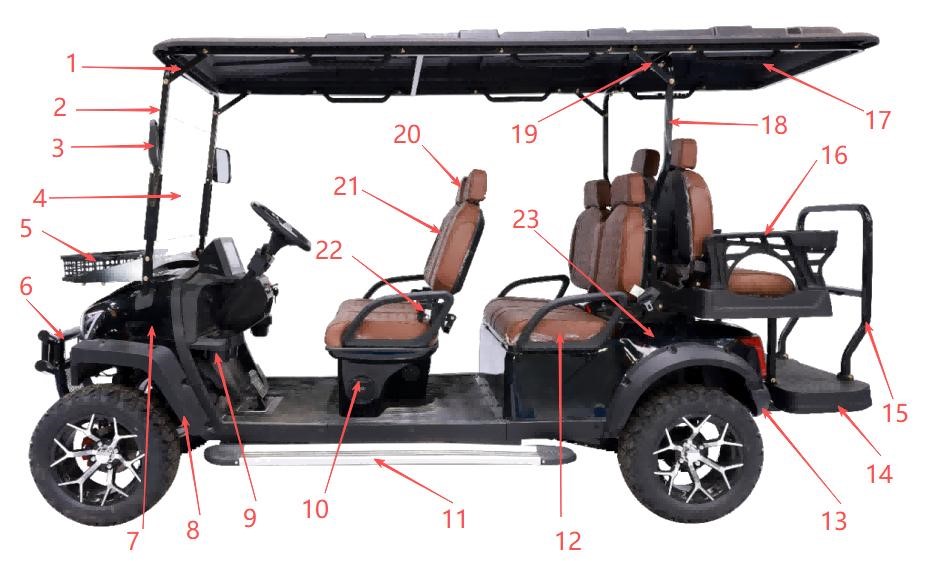
1. Front tie rod | 11. Step for getting on the vehicle |
2. Front support frame for the ceiling | 12. Seats |
3. Rearview mirror | 13. Rear fender |
4. Windshield | 14. Foot pedal |
5. Cargo basket | 15. Rear armrest support |
6. Front bumper | 16. Seat armrest bracket |
7. Front body | 17. Ceiling |
8. Front mudguards | 18. Rear support frame for the roof |
9. Water cup holder | 19. Rear tie rod |
10. Seat base | 20. Headrest 21. Backrest 22. Seat belt 23. Rear body |
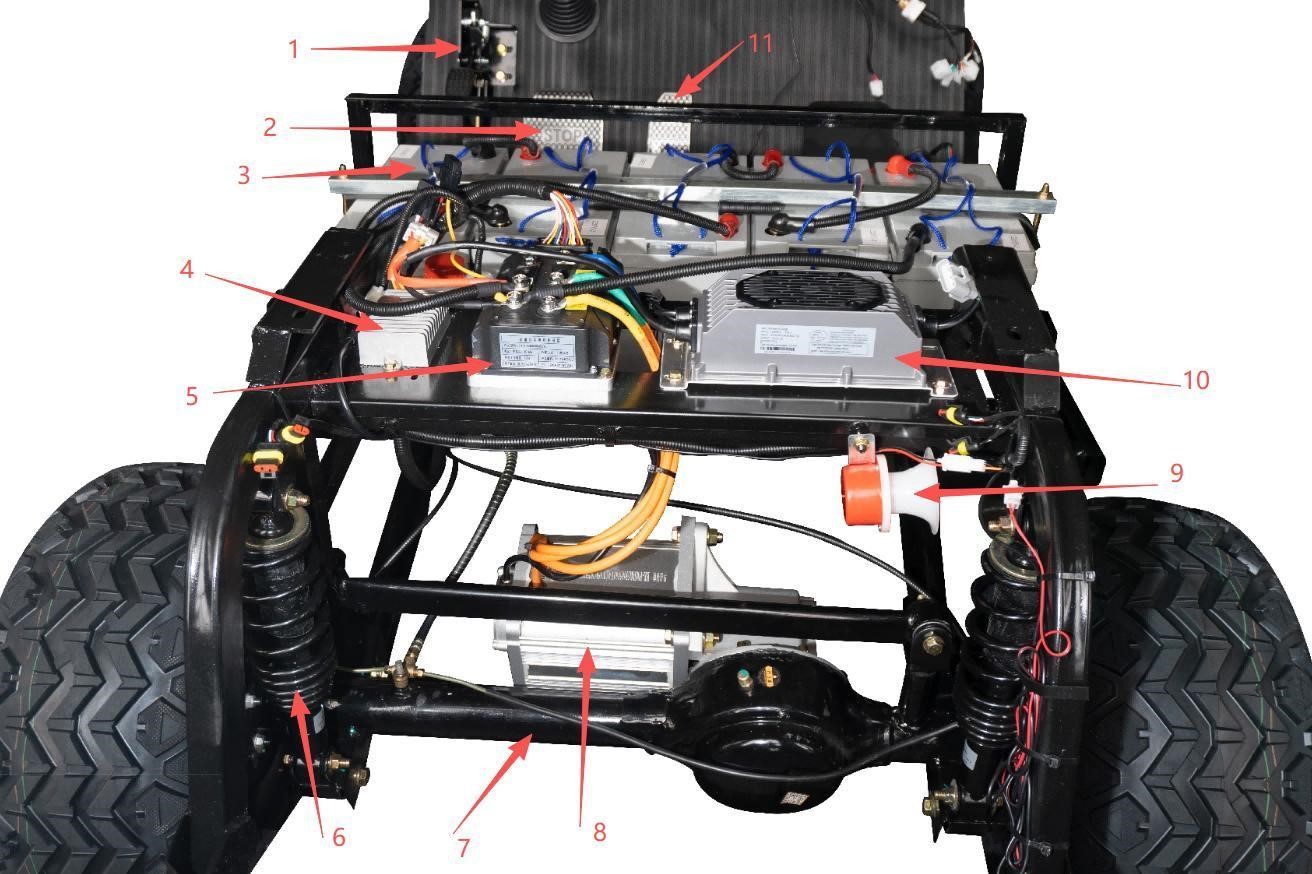
1. Parking pedal | 7. Rear axle |
2. Brake pedal | 8. Motor |
3. Battery | 9. Speaker |
4. DC converter | 10. Charger |
5. Controller | 11. Accelerator pedal |
6. Rear shock absorber |
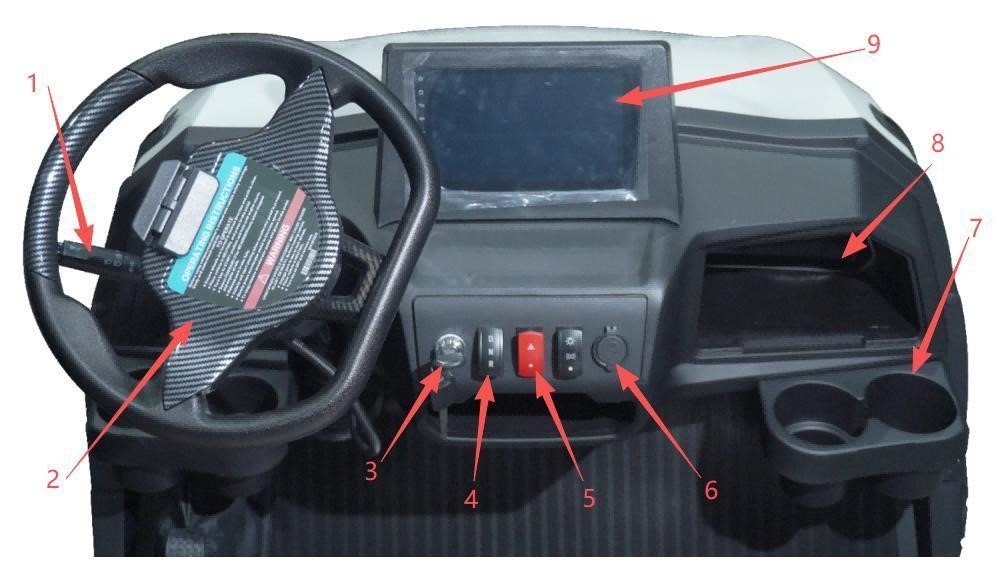
1. Light switch | 6. USB interface |
2. Defense line plate | 7. Water cup holder |
3. Key switch | 8. Storage box |
4. Gear switch | 9. Display screen |
5. Hazard warning lights |